Client
Cherkalam Mohamed Akbar
SuiteCRM Case Studies
How CRMAppz helped Cherkalam Mohamed Akbar — Class I Contractor & Supplier — connect tender tracking, EMD management, construction projects, procurement, recurring government supply contracts and monthly billing through customised SuiteCRM workflows.
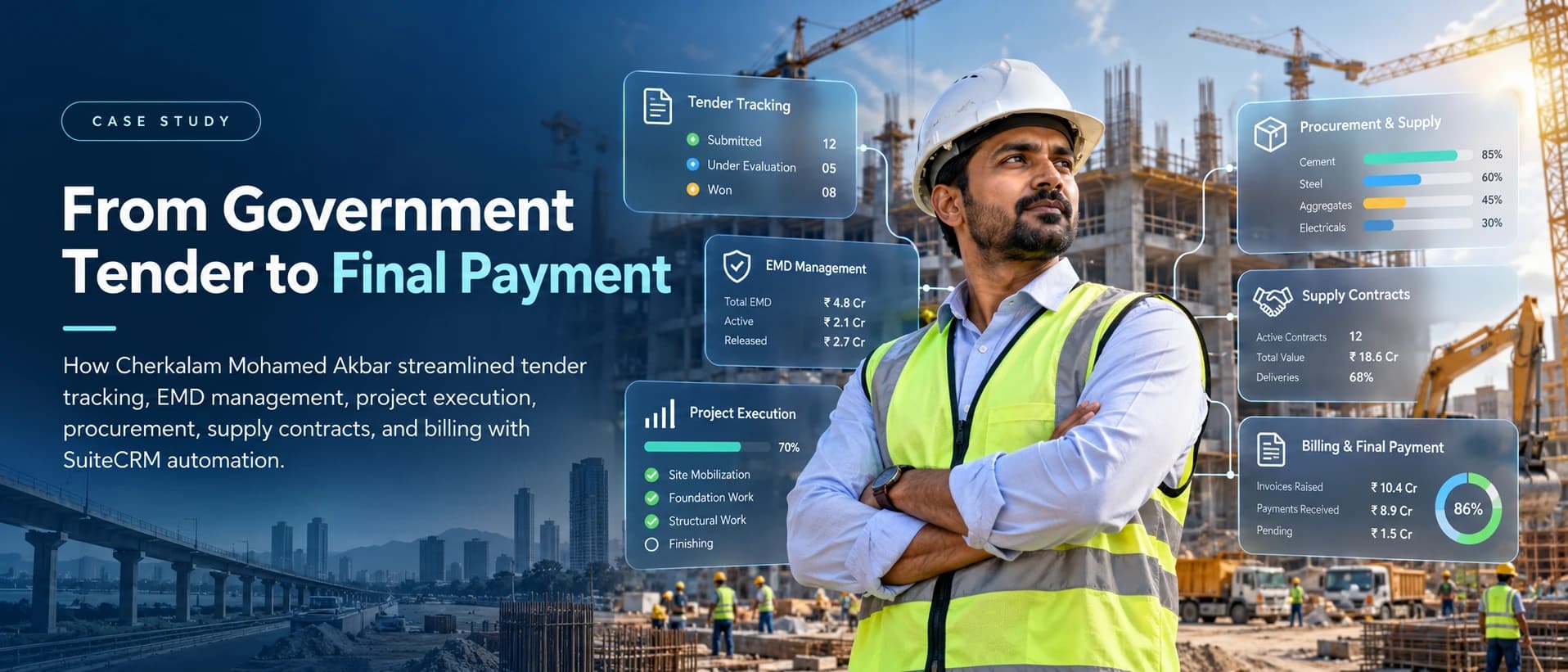
For government contractors, winning a tender is only the beginning. Every awarded contract brings responsibilities ranging from security deposits and work orders to project execution, material procurement, supplier coordination, progress monitoring, invoicing and payment collection.
Cherkalam Mohamed Akbar, a Class I Civil Contractor and Government Supply Service Provider, was handling these interconnected activities through fragmented processes involving spreadsheets, documents, emails and manual follow-ups.
With multiple tenders, construction projects and recurring government supply obligations requiring attention, the organisation needed better control over its information and operational activities.
CRMAppz implemented a customised SuiteCRM-based solution to bring these activities into a connected business management environment.
The implementation helped organise the contractor's operations, improve accountability, centralise important records and reduce dependence on disconnected manual follow-ups.
Cherkalam Mohamed Akbar
Civil Construction, Government Contracting & Institutional Supplies
Class I Contractor & Supplier
SuiteCRM, Custom Modules, Workflow Automation & Management Dashboards
Government Tender Management, Construction Project Tracking, Procurement, Vendor Management, Supply Contract Management & Billing Automation
Unlike a traditional sales business, a civil contractor's operational responsibilities begin before a contract is awarded and continue until the project is completed, billed and financially settled.
Cherkalam Mohamed Akbar participates in government contracting activities involving civil construction work and institutional supply services.
The business must coordinate government tender submissions, Earnest Money Deposits (EMDs), contract awards, work orders, construction activities, materials, vendors and departmental communication.
Construction work requires close coordination between project managers, site supervisors, suppliers, procurement personnel and accounts teams.
The organisation also handles recurring government supply obligations, including food and feed supplies for captive animals maintained at government facilities. These contracts involve scheduled deliveries, quantity verification, supply acknowledgments and monthly billing.
Although the activities are different, they share a common need: accurate contract records, timely follow-ups, operational accountability and financial visibility.
The challenge was to manage these workflows within one connected system rather than treating every department and contract as an isolated operation.
Before the CRM implementation, essential business information was distributed across spreadsheets, physical files, emails and individual employee records. Each department maintained the information it required, but management lacked a consolidated view of the business.
Several recurring operational problems created administrative overhead and made timely decision-making difficult.
The team needed to monitor multiple government tender opportunities, each with different eligibility requirements, submission deadlines, EMD amounts and evaluation stages. Information about tenders under preparation, submitted bids, technical qualification, financial evaluation and final outcomes was not consistently available in one place.
EMDs represent an important financial commitment in government tendering. The contractor needed to track deposits submitted against tenders, identify refundable amounts, monitor returns and maintain details of securities associated with awarded contracts.
After a tender was awarded, the project execution team required work orders, scope details, contract values, schedules, site information and material requirements. Because these details were maintained across different records, project teams frequently depended on manual information transfers.
Civil construction projects involve multiple execution stages, material categories, vendors and site-level activities. The team needed to monitor the Bill of Quantities (BOQ), Bill of Materials (BOM), completed work, material requirements and pending procurement.
Procurement activities involved material requests, vendor quotations, purchase orders, delivery commitments and payment follow-ups. With vendor information and purchase records maintained separately, monitoring outstanding requirements and supplier commitments required considerable coordination.
In addition to civil construction, the contractor supplied food and feed for captive animals under government contracts. These operations required maintaining supply schedules, approved items, contract rates, delivery quantities, receiving acknowledgments and monthly billing information.
Construction and recurring supply contracts had different billing requirements. Without a centralised receivables view, management had limited visibility into outstanding bills, payment status and follow-up responsibilities.
CRMAppz customised SuiteCRM around the contractor's actual operating processes, extending the platform beyond conventional lead and customer management.
The objective was to connect the entire contract lifecycle — from tender identification and bidding through project execution, procurement, billing and payment follow-up.
The solution organised government tender records, EMD details, awarded work orders, construction projects, material requirements, vendors, supply contracts, invoices and operational tasks within related CRM workflows.
Instead of maintaining isolated information across departments, the team could work with structured records and clearly assigned responsibilities.
Automated reminders and management dashboards supported ongoing monitoring of important activities and deadlines.
Government tenders could be recorded and monitored through a structured tender management workflow. Each tender record brought together the issuing department, tender reference, project description, estimated value, submission deadlines, bid documents, EMD requirements and tender status. The system helped the team monitor opportunities across the bidding lifecycle: Tender Identified → Under Evaluation → Bid Preparation → Submitted → Technical Evaluation → Financial Evaluation → Won / Lost / Cancelled.
EMD records were connected to their respective tenders, helping the team monitor deposits throughout the bidding process. Important information such as deposit amount, payment reference, submission date, refund status and follow-up responsibility could be maintained against each tender. Related contract securities and bank guarantee records could also be tracked with relevant dates and responsibilities.
Once a government tender was awarded, the corresponding contract information could be carried forward into the project management workflow. The project record connected the awarded tender with its work order, contract value, execution period, responsible team, supporting documents and operational activities.
Project management workflows helped organise construction activities into identifiable stages, tasks and milestones. Site teams could record activity status, work progress, pending tasks, execution issues and relevant supporting information.
Construction project information was organised to support tracking of BOQ items, material requirements and procurement activities. BOQ records provided a reference for planned and executed work quantities, while BOM information supported material planning. Connecting material requirements to procurement activities improved coordination between site personnel and the purchasing team.
Supplier and procurement information became part of the connected operational workflow. Vendor records supported centralised contact information, purchase history, quotations, procurement references and follow-up activities. Purchase requests and purchase orders could be linked to the relevant project and supplier.
The customised CRM workflow also supported recurring government supply contracts, including food and feed supplies for captive animals. Supply records could be maintained against their respective government contracts, helping the team track scheduled deliveries and associated documentation. Delivery quantities and acknowledgments supported verification of fulfilled supply obligations.
The billing workflow helped consolidate the information required to prepare and monitor invoices for construction and recurring supply contracts. Invoice records helped the accounts team monitor billing periods, invoice numbers, submitted amounts, payment status and supporting documents. Outstanding payment reports and reminders made it easier to identify invoices requiring follow-up.
Workflow automation helped reduce reliance on individual employees remembering every deadline and follow-up. Dashboards brought key operational information into a consolidated management view across tender activity, awarded work, project execution, procurement status, supply obligations and outstanding payments.
Tender records, submission status, bid outcomes and documentation became easier to maintain and review. Management could identify active opportunities, monitor upcoming deadlines and review previously submitted bids.
EMD records became easier to associate with individual tenders. Accounts personnel could identify pending refunds and maintain clearer follow-up responsibilities for outstanding deposits and related securities.
Awarded tenders could be associated with project records and execution activities. This helped maintain continuity between the bidding, administration, project management and accounts teams.
Project-related material requirements, supplier details and purchase activities became more traceable. Site teams and procurement personnel had a clearer process for communicating pending requirements and following up on purchases.
Animal-feed supply obligations could be monitored through structured contract, delivery and billing records. This helped organise recurring supply schedules and supported more consistent monthly billing preparation.
Billing records and payment follow-ups were brought into a more organised process. The accounts team could monitor submitted invoices and identify pending collections with less dependence on disconnected records.
Centralised information, structured task ownership, reminders and dashboards helped the organisation move away from entirely person-dependent processes. Teams gained a more consistent way to record activities, communicate status and follow up on pending work.
For Cherkalam Mohamed Akbar, the primary value of the implementation was bringing visibility and structure to several interconnected business activities.
Previously, tendering, project execution, procurement, government supply contracts and billing depended heavily on separate records and manual coordination.
By implementing customised SuiteCRM workflows, the organisation established a more connected approach to managing these activities.
The system helped improve operational transparency, clarify responsibilities, organise project and contract information and support timely follow-ups.
It also gave management a broader view of the business — from tenders under consideration to awarded projects, material requirements, upcoming supply commitments and outstanding government payments.
Rather than treating CRM as a standalone sales tool, the implementation demonstrated how a customised platform could support day-to-day operational management for a civil contractor and government supply provider.
Government contracting involves more than winning opportunities. A contractor must coordinate bidding, financial securities, work orders, project execution, material procurement, vendor relationships, supply commitments, invoices and payment follow-ups.
Traditional CRM functionality alone does not cover all these requirements. However, SuiteCRM's flexible architecture allows custom modules, relationships, workflows, dashboards and integrations to be developed around the organisation's specific processes.
For civil construction and government supply businesses, a customised implementation can provide:
These capabilities can be adapted to the requirements of civil contractors, infrastructure companies, public works contractors, maintenance service providers and institutional suppliers.
Frequently asked questions
Yes. SuiteCRM can be customised to record tender opportunities, eligibility requirements, submission deadlines, bid documents, tender evaluation status and contract award outcomes. Automated reminders and dashboards can help teams monitor the tender lifecycle.
A customised CRM can connect EMD records to individual tenders, track deposit amounts and references, monitor refunds and assign financial follow-up activities. It can also support tracking of bank guarantees and other contract securities.
Yes. Custom project workflows can connect awarded work orders with milestones, activities, progress updates, documents, responsible employees, procurement and billing records.
Yes. Custom modules or integrations can organise construction BOQ and BOM information and link material requirements to project activities and purchase requests. Specialised estimating, measurement certification and inventory functions may require additional development or integration.
Yes. Supplier details, purchase requests, quotations, purchase orders, delivery status and procurement follow-ups can be organised within customised CRM workflows.
Yes. A tailored solution can track supply contracts, approved items, agreed rates, delivery schedules, quantity acknowledgments and recurring invoice records.
Yes. Invoice preparation can be supported using approved contract rates and accepted supply quantities. Government-specific invoice formats, GST treatment and accounting requirements must be configured based on the organisation's needs.
Yes. Custom dashboards can consolidate information about tenders, EMDs, awarded contracts, project milestones, procurement activity, scheduled supplies, invoices and pending payments.
Yes. Similar CRM architecture can be customised for public works contractors, infrastructure businesses, institutional suppliers, maintenance contractors and project-based service providers.
Design and implement CRM modules, relationships, permissions and workflows around construction, tendering, procurement and government contracting operations.
Learn more →Automate recurring administrative tasks, follow-up reminders, activity assignments, approval routing and operational notifications.
Learn more →Connect CRM with compatible accounting, inventory, communication and external business applications when needed.
Learn more →Provide management visibility into bids, projects, procurement, supplies, invoicing and pending financial commitments.
Learn more →Let’s build your connected operations
Still managing tenders, EMDs, construction projects, vendor purchases and monthly invoices across spreadsheets? Whether you manage government infrastructure projects, civil construction contracts, recurring institutional supplies or a combination of these services, our team can help assess your processes and design a connected management solution.