Business automation assessment
Map a workflow, identify manual handovers and establish which improvement is worth scoping first.
Services
Every service describes engineering work and a business outcome, not a marketing package. Services compose into a single connected system, and you can start wherever your pain is sharpest.
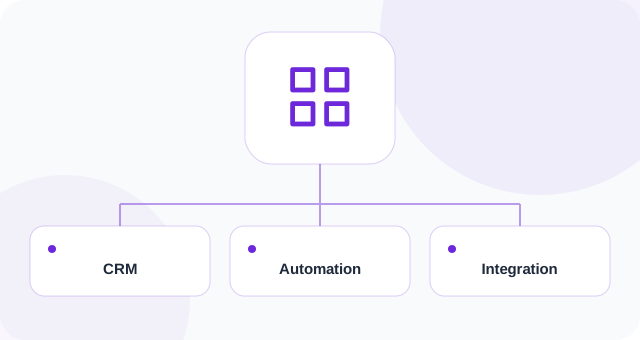
CRM organises relationships and responsibilities. Integration moves information between authoritative systems. Automation coordinates repeatable actions. Applications provide a purpose-built user experience, while reporting makes agreed measures visible. AI can assist selected tasks when its information, limits and oversight are defined.
These capabilities can work together, but they do not all belong in every project. Begin with the operating problem and choose the smallest useful scope.
Implement, customise and modernise open-source CRM around your target process.
Learn more →Connect your systems reliably via REST, GraphQL and WhatsApp Business Cloud API.
Learn more →Automate hand-offs, approvals and synchronisation, engineered for reliability.
Learn more →Governed AI agents and retrieval assistants with oversight and limits.
Learn more →Connected Next.js, Node.js, PHP and Flutter applications.
Learn more →Sound data models and decision-ready dashboards.
Learn more →Map a workflow, identify manual handovers and establish which improvement is worth scoping first.
Examine interfaces, ownership boundaries and failure handling where existing systems need to work together.
Bring a bounded requirement and review its assumptions, dependencies and acceptance criteria before delivery begins.
The proposed scope should state the users and workflows covered, the systems involved, the deliverables and what is excluded. Access, third-party charges, hosting, migration and support responsibilities need explicit treatment.
Acceptance should describe observable behaviour: who can complete the workflow, how an exception is handled and what evidence demonstrates that the result works. Changes discovered during delivery should be assessed against that agreed scope.
Frequently asked questions
Yes. A review can identify whether configuration, integration, data quality or a focused extension will address the problem. Existing constraints inform the scope.
Yes. A first stage can cover one workflow, team or integration, with later work informed by validation and operating experience.
Pricing follows the agreed scope, dependencies and delivery responsibilities. Describe your requirements so that the work can be assessed rather than inferred from a generic package.
Let’s build your connected operations
Share your current systems and the process you want to improve.