Your Real Estate Business Already Runs on WhatsApp. Why Doesn't Your CRM?
For many real estate businesses in Dubai and across the UAE, WhatsApp is already where business happens — enquiries, voice notes, brochures, site visits, after-sales. This guide shows how to connect those conversations to SuiteCRM, AI and workflow automation across the complete investor lifecycle.
Discuss Your WhatsApp CRM Requirements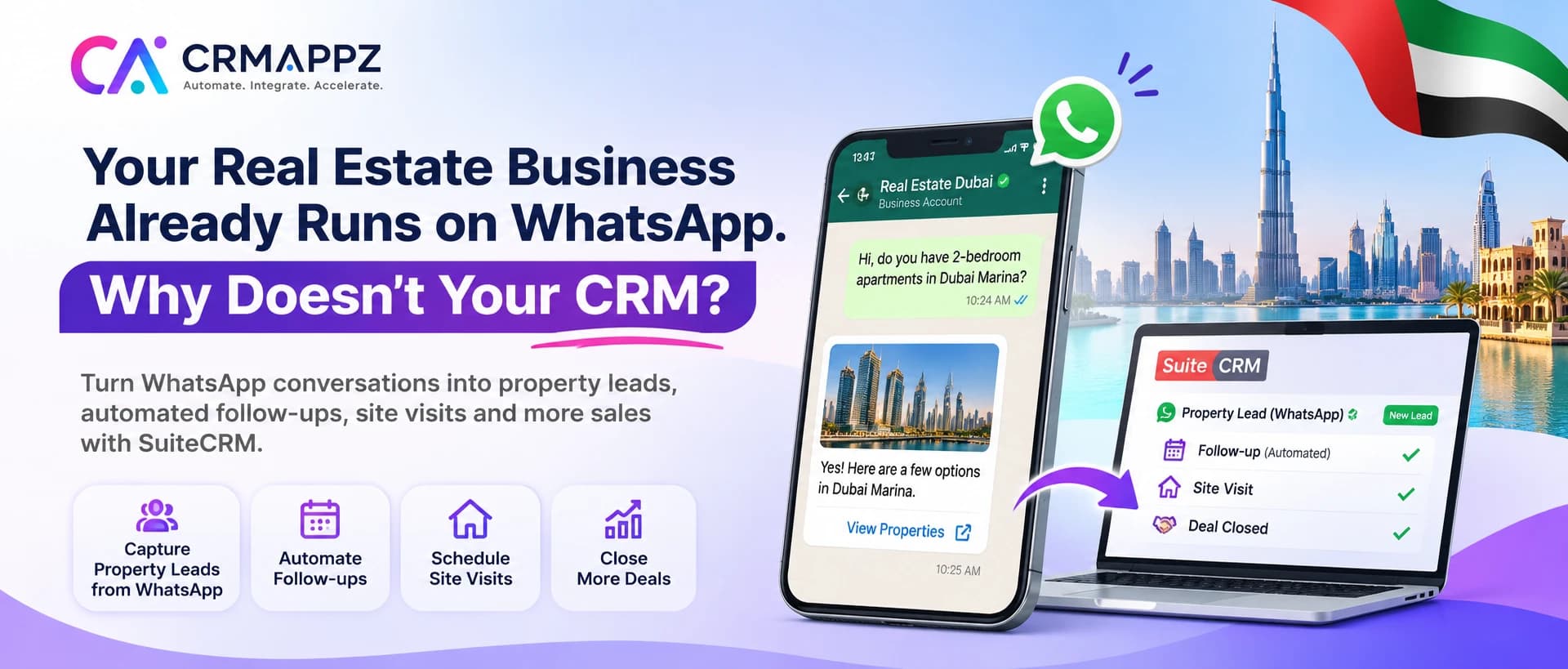
Building a WhatsApp-first, AI-powered SuiteCRM for UAE real estate businesses — connecting property enquiries, investor qualification, property recommendations, sales and long-term customer relationships.
Category: CRM Integration & Business Automation
Author: CRMAppz Engineering Team
On this page
- WhatsApp Has Become the Unofficial CRM of Real Estate
- Why UAE Real Estate Needs a Different CRM Approach
- The Hidden Cost of Disconnected Customer Conversations
- Do You Really Need Another WhatsApp CRM?
- What a WhatsApp-First SuiteCRM Architecture Looks Like
- Turning Social Media Engagement into Property Enquiries
- Intelligent Investor Qualification Through WhatsApp
- Turning WhatsApp Voice Notes into Structured Investor Profiles
- Connecting Investor Requirements with Property Inventory
- Automating Consultations, Paid Advisory and Site Visits
- Managing the Complete Real Estate Sales Lifecycle
- Automated WhatsApp Follow-ups and Investor Nurturing
- What Happens After the Property Is Sold?
- Building Long-Term Investor Portfolios
- Turning Real Estate Content into a Lead Generation Ecosystem
- A Mobile-First CRM for Real Estate Professionals
- Can You Keep Your Existing WhatsApp Business Number?
- Understanding WhatsApp Automation Limitations
- Why SuiteCRM Instead of a Conventional WhatsApp CRM?
- Data Ownership, Security and UAE Compliance
- Understanding the Business Value of WhatsApp CRM Automation
- A Practical Implementation Roadmap
WhatsApp Has Become the Unofficial CRM of Real Estate
Consider a typical day for a real estate consultant in Dubai. An investor from India asks about an off-plan development. Another customer sends a voice note explaining their budget and preferred payment plan. A property owner wants to discuss selling an existing apartment. A developer shares updated inventory. An overseas investor wants to arrange a consultation before visiting the UAE. An existing customer has a question about an upcoming developer payment.
All of these may happen on the same phone, sometimes within the same hour. The realtor may already use a CRM, spreadsheets, a calendar, email and several property-listing platforms — but the actual customer communication happens through WhatsApp.
For an independent consultant this is initially manageable. As enquiry volumes grow, the business becomes more dependent on memory, manual notes and individual follow-ups. For a growing brokerage with multiple agents, management needs visibility into enquiries, opportunities, agent performance and ongoing relationships. At that point the business does not need more communication tools — it needs its communication channels to become part of its business-management system.
Why UAE Real Estate Needs a Different CRM Approach
The UAE market serves a diverse base: local buyers, expatriates and international investors. A customer purchasing from overseas may need many conversations before deciding — understanding the market, evaluating developers, comparing communities, reviewing payment plans, exploring financing and arranging a visit. Their requirements may change along the way. An investor who enquires about a studio may eventually consider a two-bedroom; another may start in Dubai and purchase in Abu Dhabi or Ras Al Khaimah.
A typical international investor journey looks like this:
Market discovery -> Initial enquiry -> Investor qualification -> Consultation
-> Property comparison -> Site visit -> Reservation -> Purchase
-> After-sales -> Portfolio review
The important distinction is that a property enquiry does not always represent an immediate sales opportunity. Sometimes it is the beginning of a relationship that continues for several years. A real estate CRM therefore needs to understand more than names, numbers and sales stages. It may need to manage:
- International investor profiles, budgets and objectives
- Preferred locations and communities
- Developers, projects and ready or off-plan properties
- Unit availability, pricing and payment plans
- Consultations, site visits and multiple transactions
- Brokerage commissions, documentation and handover
- Long-term investor portfolios
WhatsApp becomes considerably more valuable when connected to these business processes.
Do You Really Need Another WhatsApp CRM?
There are several ways to manage WhatsApp communication, and they are fundamentally different requirements.
| Approach | Suitable for |
|---|---|
| WhatsApp Business application | Independent agents with manageable customer volumes |
| Dedicated WhatsApp messaging platform | Teams requiring shared inboxes and conversational automation |
| WhatsApp-integrated SuiteCRM | Businesses requiring customised sales, property and operational workflows |
A messaging platform manages customer conversations. A CRM manages what those conversations mean to the business. A single conversation with an investor could create a customer record, update an investment profile, identify potential properties, schedule a consultation, create a sales opportunity and initiate future follow-ups — connected business activities, not simply messaging features.
What a WhatsApp-First SuiteCRM Architecture Looks Like
SuiteCRM provides an open-source CRM foundation that can be extended through custom modules, APIs and business workflows. A WhatsApp-first real estate solution can be designed around five interconnected layers.
Customer acquisition
Customers discover the business through YouTube, Instagram, Facebook, LinkedIn, Google Ads, property portals such as Property Finder and Bayut, company websites, direct enquiries and referrals.
Customer communication
The official WhatsApp Business Platform provides supported messaging, interactive journeys, approved templates and conversation events. Customers continue through a familiar interface without downloading another app or creating a separate account.
Integration and workflow automation
An integration layer connects WhatsApp with SuiteCRM, calendars, property systems, payment gateways and other applications. Tools such as n8n and custom APIs handle incoming message processing, lead creation and duplicate prevention, agent assignment, automated follow-ups, appointment synchronisation, payment confirmation, delivery tracking, consent and opt-out validation, and integration error handling.
Artificial intelligence
AI assists with interpreting conversations and extracting useful information: voice-note transcription, multilingual communication, investor-requirement extraction, conversation summaries, enquiry classification, lead prioritisation, property-recommendation assistance and content generation.
Centralised business management
SuiteCRM remains the central system of record. A customised real estate implementation may include the following modules.
| SuiteCRM module | Business responsibility |
|---|---|
| Leads and Contacts | Customer information and engagement history |
| Investor Profiles | Investment objectives, budgets and preferences |
| Developers | Developer information and relationships |
| Projects | Property developments and communities |
| Properties and Units | Inventory, pricing and availability |
| Payment Plans | Developer instalment structures |
| Opportunities | Active property transactions |
| Property Recommendations | Properties shortlisted and shared |
| Appointments and Site Visits | Consultations and property viewings |
| Transactions | Reservations and completed purchases |
| Commissions | Brokerage and agent revenue |
| Investor Portfolios | Multiple property investments |
| After-sales Cases | Documentation, handover and customer support |
| Marketing Campaigns | Lead sources and campaign performance |
Digital marketing channels -> WhatsApp -> AI & workflow automation
-> SuiteCRM -> Real estate operations -> Customer engagement
WhatsApp becomes the principal engagement channel, SuiteCRM the business-management platform, and AI the layer connecting unstructured conversations with structured business information.
Intelligent Investor Qualification Through WhatsApp
Not everyone enquiring about real estate wants the same service. Some want to invest immediately; others are exploring the market, considering a resale, reviewing a portfolio or seeking advice. A WhatsApp-first CRM can introduce different qualification journeys based on intent. A customer may begin by selecting one of four options.
- Invest in UAE real estate — capture budget, preferred emirate, property type, payment preferences, objectives and purchase timeline.
- Sell an existing property — capture location, developer, project, unit configuration, ownership information and expected price.
- Portfolio advice or a second opinion — understand existing investments, concerns, advisory requirements and consultation preferences.
- Meet the team — let customers arrange a conversation with a property consultant directly.
The questions can be delivered through supported WhatsApp interactive messages or Flows. Responses are recorded in the relevant SuiteCRM modules, and the assigned realtor receives a structured overview with recommended next actions. A customer with an established budget and an immediate timeline needs a different follow-up from someone exploring for a future investment.
Turning WhatsApp Voice Notes into Structured Investor Profiles
International investors often find it easier to explain their requirements in a voice message than to complete a long form. Consider an illustrative voice note: "I am based in India and looking to invest around AED 2 million in Dubai. I prefer an off-plan apartment with a flexible payment plan. I am looking for long-term appreciation and rental income. I am planning to visit Dubai in the next three months."
Traditionally the realtor would listen, interpret, take notes and update the CRM by hand. An AI-powered WhatsApp integration can automate much of that administration.
Investor sends a voice note
The customer explains their requirements naturally in WhatsApp.
Integration retrieves the audio
The supported integration pulls the audio message for processing.
AI transcribes the recording
Speech is transcribed, with multilingual support subject to recording quality.
Requirements are extracted
Budget, location, property type, objectives and timeline are identified.
SuiteCRM updates the profile
An investor profile is created or updated and missing information is flagged.
A summary and task are created
A conversation summary is generated and the assigned realtor receives a follow-up task.
| Investor information | AI-extracted details |
|---|---|
| Customer residence | India |
| Approximate investment budget | AED 2 million |
| Preferred location | Dubai |
| Property type | Off-plan apartment |
| Payment preference | Flexible payment plan |
| Investment objective | Capital appreciation and rental income |
| Planned UAE visit | Within three months |
| Funding method | Not provided |
| Preferred community | Not provided |
| Suggested next action | Qualification consultation |
AI can support English, Arabic, Hindi and other languages, subject to transcription accuracy and recording quality. For independent consultants, the process can begin with a genuine prerecorded personal introduction; the customer replies with a voice note and continues naturally, while SuiteCRM organises the information behind the scenes.
Is your real estate business losing opportunities between WhatsApp and your CRM?
Connect property enquiries, AI-powered investor qualification, automated follow-ups, property recommendations and after-sales workflows with a customised SuiteCRM solution.
Connecting Investor Requirements with Property Inventory
Qualification becomes far more useful when connected to structured property information. Agents receive brochures, floor plans, payment plans and inventory updates from many developers, distributed across spreadsheets, emails, portals and WhatsApp. A customised SuiteCRM can organise this into a centralised inventory holding developer, project and community, emirate and location, property type, unit configuration, size, current price, availability, payment plan, expected handover, floor plans and brochures, advertising-permit information, commission structure and the last verified date.
Once inventory and investor requirements are structured, a matching engine can compare the two.
| Matching criterion | Purpose |
|---|---|
| Investment budget | Identify properties within financial limits |
| Preferred location | Match relevant emirates and communities |
| Property configuration | Identify suitable unit types |
| Payment plan | Compare available instalment structures |
| Investment objective | Support relevant property selection |
| Handover timeline | Match the investor's purchase requirements |
| Availability | Exclude unavailable or unconfirmed inventory |
The realtor reviews the suggested properties before sharing recommendations through WhatsApp, and the CRM records which were shared, shortlisted, rejected or selected — building a clearer understanding of each customer's preferences over time.
Automating Consultations, Paid Advisory and Site Visits
International sales involve considerable coordination across countries and time zones, and a consultant may spend several WhatsApp conversations arranging a single appointment. A WhatsApp-integrated SuiteCRM can connect qualification with calendar and appointment management. After qualification, the investor receives a booking link showing available slots.
Through integrations with Google Calendar, Google Workspace and suitable scheduling platforms, the system can display availability in the customer's time zone, schedule phone or video consultations, generate meeting links, schedule physical and virtual viewings, create CRM meeting records, send confirmations and reminders, and handle rescheduling and cancellations.
Supporting paid real estate advisory
Some consultants provide paid services such as independent project assessments, portfolio reviews and investment consultations. A payment gateway can be integrated with the booking process: the customer selects a service, pays through a secure hosted page and receives a confirmed appointment after payment verification. SuiteCRM records the advisory service, payment status, meeting and customer information, so the business can distinguish advisory revenue from sales commissions.
Managing the Complete Real Estate Sales Lifecycle
A single traditional pipeline rarely represents the different activities of a real estate organisation. Purchases, resales, advisory services and after-sales need different workflows, and SuiteCRM can be configured around these distinct processes.
New enquiry -> Qualified investor -> Consultation -> Market orientation
-> Property shortlist -> Site visit -> Negotiation -> Reservation -> Purchase
Seller enquiry -> Property assessment -> Listing approval
-> Buyer enquiries -> Property viewing -> Offer -> Transfer
Service enquiry -> Qualification -> Payment -> Consultation booked
-> Advisory completed -> Follow-up
After-sales:  Property purchased -> Documentation -> Payment milestones
             -> Construction updates -> Handover -> Ongoing support
Repeat:       Portfolio review -> New requirement -> Recommendations
             -> Consultation -> New transaction
The relationship stays connected across these workflows: a single investor can have multiple opportunities, completed transactions and ongoing advisory activities. Management can monitor active opportunities, qualified investors awaiting consultations, shortlisted properties, upcoming site visits, stalled negotiations, expected and closed transaction values, expected and received commissions, and outstanding service requests.
Automated WhatsApp Follow-ups and Investor Nurturing
Real estate decisions may take weeks or months, and a customer who is not ready today may become a valuable investor later. Maintaining contact with hundreds of potential investors manually is difficult. A WhatsApp-first CRM can introduce structured, permission-based nurturing.
| Stage | Customer communication |
|---|---|
| Initial enquiry | Introduction and service selection |
| Qualification completed | Relevant educational information |
| Consultation booked | Appointment confirmation and reminder |
| Consultation completed | Personalised follow-up |
| Properties shortlisted | Relevant project information |
| Long-term prospect | Periodic market insights |
| UAE visit approaching | Site-visit coordination |
| Existing investor | Relevant portfolio-review invitation |
Timing and frequency should depend on customer preferences, engagement, applicable messaging rules and business requirements. SuiteCRM can maintain consent, communication preferences and opt-out records, and automation should check these before initiating marketing communication. The system can also pause automated messages when a realtor takes over a conversation, so customers do not receive inappropriate automated follow-ups while actively discussing a transaction.
What Happens After the Property Is Sold?
For many CRM implementations the process ends when an opportunity is marked closed-won. For off-plan real estate, that may be the beginning of several years of interaction. An overseas investor may need help with sales and purchase agreements, developer payment schedules, property registration, outstanding documentation, construction updates, handover appointments, snagging and inspection, rental-management referrals, property queries and future investment decisions.
When these activities stay inside individual WhatsApp conversations, it becomes hard to track responsibilities and outstanding actions. A customised SuiteCRM after-sales module can connect purchased properties with payment milestones, documents, customer requests and service activities. When a verified developer payment milestone approaches, the CRM can create a follow-up task and send an appropriate WhatsApp reminder where permitted; when an investor raises a documentation issue, the conversation can trigger a service case.
Building Long-Term Investor Portfolios
An investor may purchase several properties over time, sell existing investments, request portfolio reviews or explore new opportunities as their objectives evolve. Managing this requires more than a contact record. A dedicated investor-portfolio module can bring together properties purchased, original transaction values, developer information, payment schedules, outstanding obligations, handover dates, rental-income information where available, estimated valuations from identified sources, previous consultations, investment preferences and future requirements.
The realtor can prepare for a meeting by reviewing the consolidated portfolio instead of searching through conversations and spreadsheets. The CRM can also identify upcoming milestones and opportunities for relevant follow-up — a customer approaching handover needs a different discussion from one considering another off-plan purchase. This supports longer-term relationships rather than treating every enquiry as an isolated transaction, and creates opportunities for repeat business and referrals.
Turning Real Estate Content into a Lead Generation Ecosystem
Many consultants invest substantial time researching the market and creating educational YouTube content that never reaches its full potential. A detailed script can become the foundation for several marketing assets.
| Original content | Repurposed output |
|---|---|
| YouTube investment video | SEO-optimised website article |
| Market analysis | LinkedIn newsletter |
| Key investment insights | Instagram carousel |
| Property education | Facebook carousel |
| Frequently asked questions | YouTube Shorts and Reels scripts |
| Market observations | Email newsletter |
| Investor education | WhatsApp community update draft |
| Property comparison | Downloadable investment guide |
An AI-powered workflow can generate drafts from the original script, and an automation platform such as n8n can coordinate review, approval and supported publication:
YouTube script -> AI content generation -> Editorial review
-> Multi-channel distribution -> Tracked enquiry links
-> WhatsApp qualification -> SuiteCRM
Each asset can include a relevant call to action — a reader requests a consultation, a viewer starts a WhatsApp enquiry, a follower downloads a guide — and the CRM connects these interactions to records and opportunities where attribution is available.
A Mobile-First CRM for Real Estate Professionals
Real estate professionals do not spend their day at a desktop. They attend developer meetings, conduct viewings, meet investors and travel between locations. If an agent must navigate many screens and update numerous fields after every conversation, adoption becomes difficult. A WhatsApp-first SuiteCRM can introduce a simplified mobile workspace. A realtor's daily dashboard could display:
- New property enquiries and unread conversations
- Qualified investors requiring attention
- Today's consultations and upcoming site visits
- Recommended follow-up actions
- Properties awaiting review
- Active sales opportunities
- Customer payment milestones
- Outstanding after-sales requests
An independent consultant may manage these directly from a mobile browser. A brokerage may need shared conversation queues, automatic lead assignment, manager approvals and agent-performance monitoring. Both can use the same underlying SuiteCRM architecture — the interface and workflow complexity can grow with the business.
Can You Keep Your Existing WhatsApp Business Number?
For many businesses the existing WhatsApp number represents years of customer relationships, and replacing it can be disruptive. Preserving it should be considered before introducing automation. Eligible accounts may support coexistence, allowing supported WhatsApp Business app functionality and official Business Platform capabilities on the same number — but eligibility and functionality depend on the account, onboarding method, provider and current Meta requirements. Before implementation, assess:
Account and number
- Existing WhatsApp account type
- Business verification requirements
- Number eligibility and coexistence support
- Linked-device compatibility
- Number migration and fallback procedures
History, templates and consent
- Historical conversation synchronisation
- Existing group and community requirements
- Approved message templates
- Customer consent records
Understanding WhatsApp Automation Limitations
WhatsApp automation is valuable, but it is important to understand what can and cannot be automated reliably. The WhatsApp Business application and the official WhatsApp Business Platform do not necessarily offer identical capabilities.
| Requirement | Implementation consideration |
|---|---|
| One-to-one customer messages | Supported through official messaging integrations |
| Automated qualification | Interactive messages, Flows and supported workflows |
| Voice-note processing | Supported audio handling with transcription integration |
| Automated follow-ups | Subject to messaging rules and customer preferences |
| Marketing campaigns | Appropriate permissions and approved templates where required |
| Existing chat history | Depends on onboarding and provider capabilities |
| WhatsApp groups | Subject to separate platform capabilities and eligibility |
| Property portal integration | Depends on authorised access |
| Existing number coexistence | Account-specific eligibility |
| Automated investment advice | Requires appropriate professional oversight |
The official platform generally allows supported free-form messaging within the applicable 24-hour customer-service window after an incoming customer message; outside that window, approved templates are normally required. Current platform policies, message categories and pricing should be reviewed during implementation, and existing contact information does not automatically grant permission to send promotional campaigns. These considerations matter especially when WhatsApp is the organisation's main communication channel. Refer to the official WhatsApp Business Platform and WhatsApp Business Messaging Policy for applicable requirements.
Why SuiteCRM Instead of a Conventional WhatsApp CRM?
A conventional WhatsApp CRM may be entirely suitable when the main requirement is managing conversations, running campaigns and assigning messages to agents. A real estate organisation may eventually need capabilities beyond messaging. SuiteCRM provides a customisable open-source foundation that can represent the organisation's specific processes.
| Capability | Messaging-focused CRM | Customised SuiteCRM |
|---|---|---|
| Shared inbox | Typically available | Can be integrated |
| WhatsApp automation | Typically available | Configurable integration |
| Customer qualification | Depends on platform | Industry-specific workflows |
| Developer management | Product-dependent | Dedicated custom modules |
| Property inventory | Product-dependent | Customised relational modules |
| Investor profiling | Often generic | Dedicated investor profiles |
| Property matching | Product-dependent | Custom matching engine |
| Multiple sales pipelines | Product-dependent | Configurable workflows |
| Commission tracking | Product-dependent | Customised business logic |
| After-sales management | Often general-purpose | Property-specific workflows |
| Investor portfolios | Product-dependent | Dedicated portfolio management |
| Hosting flexibility | Vendor-dependent | Flexible deployment options |
| Source-code customisation | Often restricted | Open-source foundation |
| External integrations | Platform-dependent | API-driven architecture |
The advantage of SuiteCRM is not simply the absence of a mandatory proprietary subscription for its open-source edition. It is the ability to design a system around how the business actually operates. A property consultancy and a large brokerage do not require the same modules, workflows or interface; SuiteCRM provides a shared foundation that evolves with their requirements.
Data Ownership, Security and UAE Compliance
Real estate businesses handle sensitive information — investment preferences, contact details, property ownership and transaction documents. Connecting WhatsApp with AI, CRM and external automation introduces additional data-processing considerations, so security and privacy should be part of the architecture from the beginning.
Consent, access and secure infrastructure
SuiteCRM can maintain communication permissions, consent sources and opt-out requests; marketing workflows should validate these before sending, and opt-outs should be reflected across connected systems. Sales, management, finance and after-sales teams may need different access, so customer information and documents should be visible only to authorised users. The implementation should consider encryption, secure API authentication, multifactor authentication, role-based access control, audit logs, secure document storage, backup and recovery, data-retention policies and integration monitoring.
UAE data protection and property-marketing compliance
The UAE Federal Personal Data Protection Law establishes requirements relating to personal information, and additional obligations may apply depending on jurisdiction and activity. Hosting SuiteCRM in a UAE cloud region can provide greater control over CRM infrastructure, but local hosting does not automatically mean every connected AI, payment or messaging service processes information exclusively within the UAE — data flows should be reviewed before implementation. Automated property marketing should account for applicable advertising requirements; for Dubai operations, relevant Dubai Land Department and Trakheesi requirements should be incorporated where applicable, and permit information can be represented within the CRM to support controlled publication. Refer to the UAE Government's data-protection overview and the Dubai Land Department.
Understanding the Business Value of WhatsApp CRM Automation
The value of a WhatsApp-first CRM should be evaluated through measurable operational improvements. Consider an illustrative brokerage receiving 500 enquiries a month. If agents spend an average of six minutes manually recording requirements, updating records and organising follow-ups, that is roughly 50 hours of monthly administration. If an AI-assisted workflow reduces the average to two minutes per enquiry, the remaining activity is about 16.7 hours.
| Operational measure | Manual process | AI-assisted process |
|---|---|---|
| Monthly enquiries | 500 | 500 |
| Administrative effort per enquiry | 6 minutes | 2 minutes |
| Monthly administrative effort | 50 hours | 16.7 hours |
| Potential monthly time released | — | 33.3 hours |
| Potential annual time released | — | 400 hours |
The more important question is how the organisation uses that additional time — agents may spend more of it on consultations, research, negotiations and long-term relationships. Management can measure performance through indicators such as average lead response time, investor qualification rate, consultation booking and attendance rates, follow-up completion, property-shortlist and site-visit conversion, transaction conversion, commission revenue by marketing source, after-sales resolution time and repeat-investment activity. Automation does not guarantee more sales; it creates a better operating environment in which professionals can manage relationships and pursue opportunities.
A Practical Implementation Roadmap
Not every business needs a comprehensive platform from day one. A phased implementation establishes reliable foundations before introducing more advanced capabilities.
WhatsApp and CRM foundation
Existing-number assessment, official WhatsApp integration, SuiteCRM configuration, contact import and duplicate management, basic lead capture, communication preferences, sales pipelines, conversation history and basic dashboards — a reliable link between communication and CRM records.
AI-powered qualification
Interactive journeys, voice-note transcription, investor-information extraction, AI summaries, lead prioritisation, human-handover workflows and multilingual qualification — reducing repetitive work while improving understanding.
Sales and appointment automation
Google Calendar integration, appointment scheduling, paid-advisory workflows, WhatsApp reminders, agent task management, opportunity tracking and site-visit scheduling — connecting communication with measurable sales activity.
Real estate inventory and intelligence
Developer, project and property management, payment plans, investor-to-property matching, recommendation history and commission management — connecting qualified investors with reliable inventory.
After-sales and investor lifecycle
Transaction records, documentation workflows, payment-milestone tracking, handover management, service cases, portfolio management and repeat-investment workflows — supporting relationships beyond the initial sale.
Content automation and business intelligence
AI-assisted content repurposing, marketing-approval workflows, campaign-specific tracking, supported distribution, lead attribution and management dashboards — connecting marketing investment with qualified enquiries and revenue.
Your Real Estate Business May Not Need Another CRM. It May Need a Better-Connected One.
For many UAE real estate businesses, the most important customer interactions are already happening through WhatsApp. The opportunity is to connect those conversations with the systems that manage the rest of the business.
A property enquiry should not remain an isolated message. An investor's voice note should not require repetitive manual data entry. A property recommendation should not be disconnected from available inventory. A customer consultation should not disappear into an untracked calendar appointment. And a completed transaction should not mark the end of the relationship.
How CRMAppz can help
We approach CRM implementation by understanding the business process before deciding which technology components are necessary. For real estate organisations, that means understanding how enquiries arrive, how investors are qualified, how properties are recommended, how transactions are managed and what happens after the sale. Depending on your requirements, we can help design and implement:
- SuiteCRM implementation and customisation — industry-specific modules, investor profiles, property inventory, sales pipelines, developer management and after-sales workflows.
- WhatsApp CRM integration — official WhatsApp Business Platform connectivity, conversation management, interactive qualification journeys and automated follow-ups.
- AI agents and intelligent automation — voice-note transcription, investor qualification, conversation summaries, information extraction and property-recommendation assistance.
- Business process automation — integration with Google Workspace, appointment systems, payment gateways and marketing platforms using n8n and custom APIs.
- Mobile and web development — simplified mobile-first realtor workspaces, customer portals and management dashboards.
- Analytics and reporting — lead-source attribution, sales performance, conversion analysis, commission tracking and operational intelligence.
See how this maps to the market in our real estate automation overview, and how the messaging layer is built in our WhatsApp CRM integration guide.
Discuss Your WhatsApp CRM Requirements
Whether you are an independent property consultant, a growing Dubai brokerage or a UAE organisation managing international investors, the first step is understanding where your customer communication and business processes are disconnected. We can assess your WhatsApp environment, CRM infrastructure, investor qualification and automation opportunities.
Verification references
WhatsApp Business Platform policies, message categories and pricing, and UAE data-protection and real-estate marketing requirements, change over time. Confirm the current rules against the primary sources below before implementation.
Related knowledge
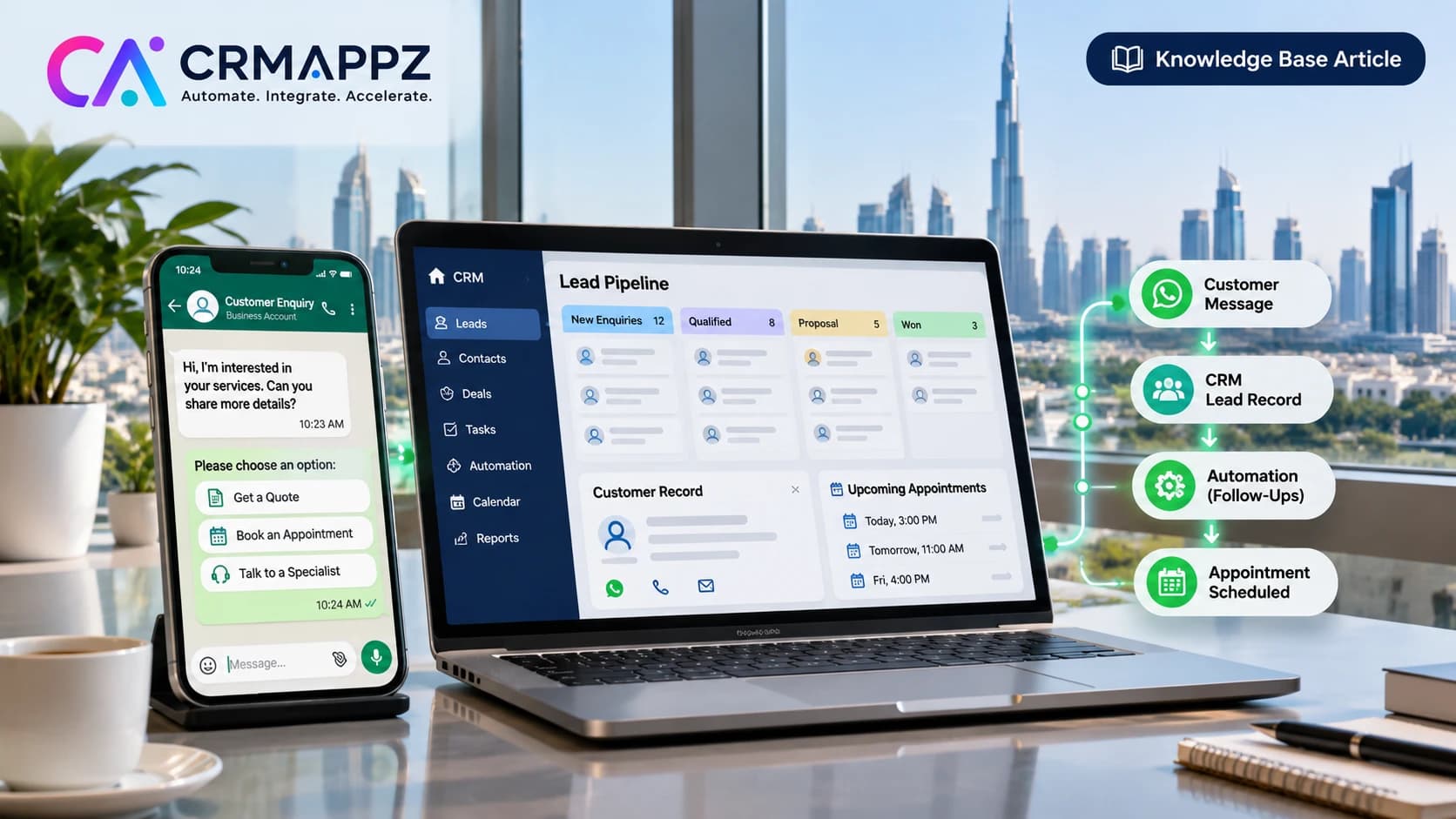 WhatsApp IntegrationWhatsApp CRM Integration in Dubai: How Small Businesses Can Automate Enquiries, Follow-Ups and AppointmentsA practical guide for Dubai businesses looking to connect WhatsApp with CRM, automate enquiry capture, manage lead qualification, schedule appointments and keep existing +971 numbers.
 WhatsApp IntegrationSchool CRM with WhatsApp: Managing Admission Enquiries from First Message to EnrolmentA practical guide for schools and institutes that receive admission enquiries on WhatsApp: capture every enquiry in a CRM, assign follow-up ownership, communicate with parents compliantly and see the admissions pipeline clearly.
Turning Social Media Engagement into Property Enquiries
Many UAE real estate professionals invest significant time creating educational content — a YouTube video on off-plan risk and reward, an Instagram carousel comparing communities, a LinkedIn article on market developments. But the journey from content engagement to a qualified opportunity is not always measurable.
Consider two investors. One discovers a realtor through a video about properties below AED 1 million; the other arrives after an article on luxury waterfront residences. Both may appear as new WhatsApp enquiries, yet their interests differ significantly. Using tracked links, campaign-specific landing pages, prefilled WhatsApp messages and supported platform integrations, SuiteCRM can retain more meaningful lead-source information.
Not every channel provides complete attribution automatically — a normal WhatsApp message does not inherently identify which video a customer watched, so that context must be captured through an appropriately designed journey where possible. Implemented correctly, the CRM can answer more valuable questions: which videos generate qualified investors, which campaigns result in consultations, which channels produce completed transactions, and which campaigns contribute most to brokerage revenue. The objective is to measure marketing through business outcomes, not clicks and message volumes.